
Board Game Review - The Elder Scrolls: Betrayal of the Second Era
Just Enough Bones

One of the very first posts I wrote on this Substack was an attempt to reckon with my bewilderment at how much I loved the Chip Theory magnum opus, Too Many Bones — an enormous dungeon-crawl-in-a-box that gives players a mountain of dice and poker chips and expects them to reference four different resources for rules while still managing to force you to look some things up online. TMB is a beautiful mess, and one I’ve invested far too much money and time into. Its intricately-crafted and unique characters, silly encounters, unfair boss fights, and hand-wavy rule interpretations have made for many a memorable night for my group. Plus, it’s waterproof!
Now, years after the original release of TMB, Chip Theory seems to have set out to reproduce its success while learning from its shortcomings with The Elder Scrolls: Betrayal of the Second Era. While the rules are still an undertaking, they’re thorough and easy to navigate. Rather than a slew of unique Gearlocs, each with their own set of dice, characters in TES are truly individualized and built by each player. Encounters are just as varied, but now give you some insight into what to expect so you’re not blindsided by too many fights in a row. Downtime is greatly expanded on, making you feel like a real character living in a world rather than a hapless passenger being shuffled along. Everything is streamlined, but simultaneously deeper. Plus, it’s waterproof!
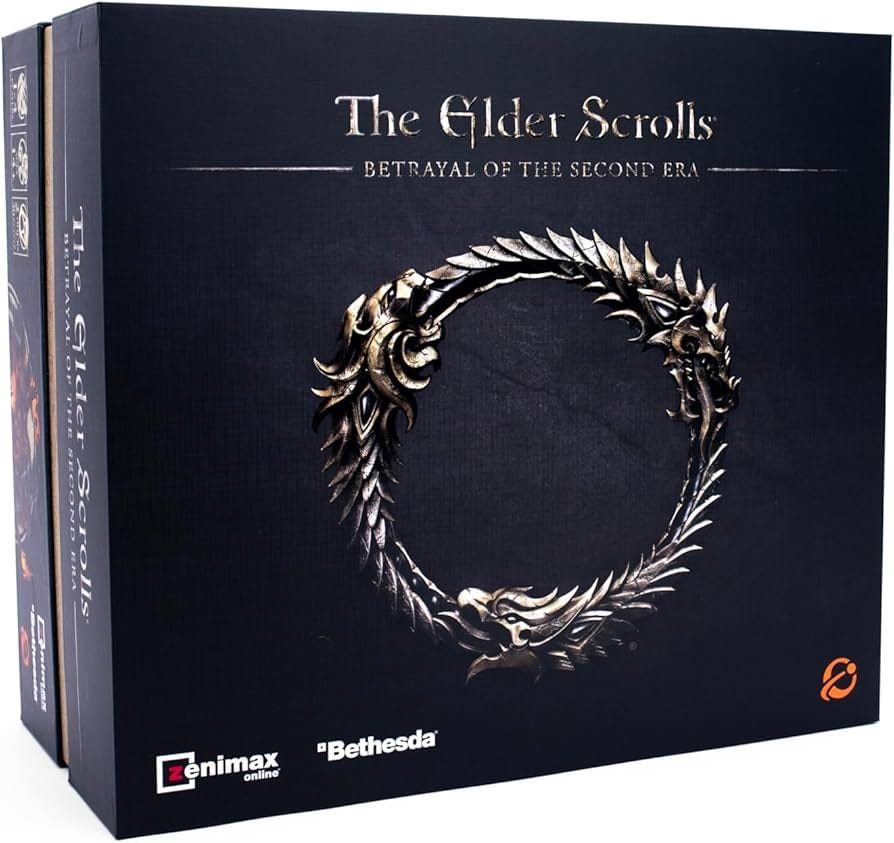
A box as massive as Betrayal of the Second Era is difficult to distill into salient points. While comparisons to its predecessors at CTG might be a helpful way for me to organize my thoughts, I’ll dispense with them henceforth for the sake of the unfamiliar. Surprisingly, as you can tell from its title, this game represents a collaboration between Chip Theory and Bethesda/Zenimax, the publishers of the Elder Scrolls series of RPG video games. While I have a decent familiarity with the source material, I will similarly refrain from too many references to it unless there is something particularly interesting to mention.
In Betrayal of the Second Era, you and up to three friends play as adventurers in the fantastical world of Tamriel and its many distinct provinces — some of which you’re likely familiar with thanks to pop culture osmosis, like Morrowind, Cyrodiil, or Skyrim. To begin, you’ll choose which of these regions you want your adventure to start in, along with what faction you’ll all be working for. The combination of these two elements will determine the general outline of your quest, which is always split into three play sessions (although, of course, nothing prevents you from just sitting down for an entire day and playing the whole thing through at once).
Each session will generally give you a particular objective, a time by which you’ll need to have achieved it, and a few choices at the end for what you’ll pursue in your next session. Usually this means traveling to a new region, but not always. Adventures are split up into days, each of which contains some kind of encounter, be that a “peaceful,” narrative interaction, a “conflict” in which you’ll be heading into battle in one fashion or another, or a visit to one of the many towns and settlements across Tamriel, where you’ll be able to perform some handy downtime activities.
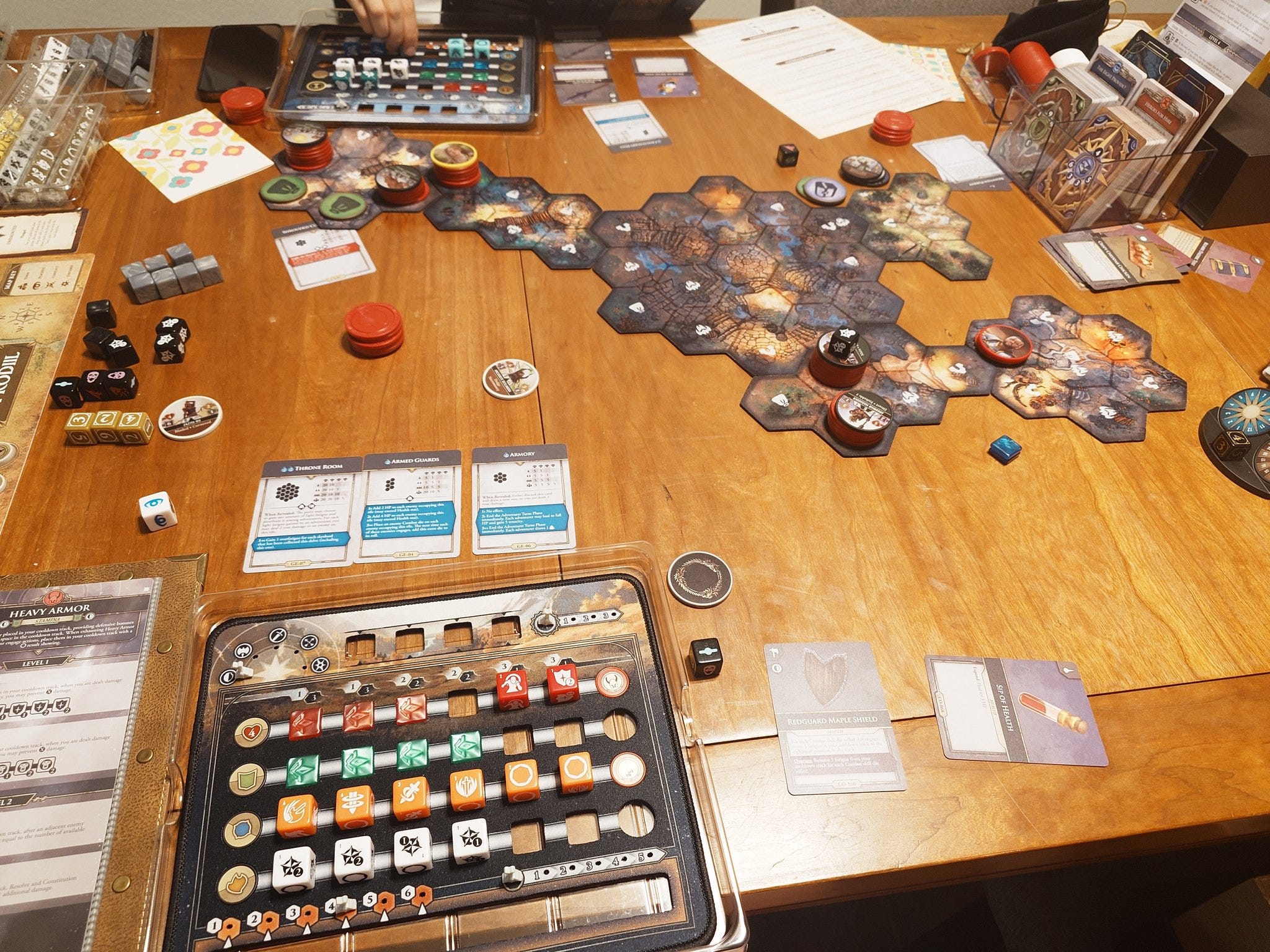
The overall flow of play is thus rather simple — each day you’ll choose where on the illustrated map of the region your group will be traveling to, deal with whatever type of encounter might happen to be there, and then rest up for the next day. Certain events might be triggered based on what day of your adventure you’re on, what region you’re in, or what encounters you’ve resolved so far, and if you stop in a town you’ll also have access to shops to buy items, trainers to teach your heroes new skills, inns to rest more fully at, and other quest- or faction-specific actions.
The number of days you’ve spent adventuring is the tool used to determine how tough your battles are going to be, and generally speaking your characters only get stronger through combat, so while you can avoid most combat situations, you’ll have a much harder time finishing your quest if you don’t adequately prepare your character with experience and loot.
Encounters are represented by two different decks of cards, one for peaceful interactions and one for combat scenarios, and at the start of your session you’ll shuffle in some additional, region-specific encounters to provide a sense of narrative cohesion without adding too much setup overhead. Similarly, in addition to the normal batch of enemies you’ll always be dealing with, the regions also have specific baddies roaming their lands that will also be added to the pool.
At the start of the adventure, players will need to create their character by choosing a race, class, and starting skill (in addition to the jack-of-all-trades “Combat” skill that every character has). Skills are represented by dice slotted into your player mat, a neoprene mousepad with holes punched out for dice and tokens representing your primary stats: Health, Magicka, and Stamina. The initial amount you have of these three stats is determined by your race, but you have the ability to increase them, as well as your proficiency with your chosen skills, every time you level up.
Health is self-explanatory — represented in battle by a pile of red poker chips underneath your player token (in true Chip Theory fashion). Stamina is generally used to determine your ability to take physical combat actions, such as how far you can move or how long your range is when attacking with a bow. Magicka functions similarly but for your magical attacks. Skill dice work a little bit differently — the aforementioned Combat skill that every character has can be used to attack or defend yourself, and you’ll start with a few of these dice on your mat. You’ll also start with the first level die of whatever other skill path you’ve chosen, which can range from things like Sword & Shield to Stealth to Speech to Necromancy.
In combat, your turn will usually look something like this: you move your character into a better position, set your combat Stance (determining if you’ll be using your dice to defend, attack with a weapon of some kind, or use magic), pick a foe to Engage, and pick up some dice to chuck at them. When you roll your pile of chosen dice, you’ll adjudicate the results in whatever order you choose. Some will activate once and immediately, some will go into the “Active” slots atop your mat to provide ongoing effects like extra damage or defense, and some you might not choose to use at all, slotting them back into your mat to roll again later and hopefully get a better result.
When dice are used up, they get “Exhausted,” which in Betrayal of the Second Era means they enter a cooldown row at the bottom of your mat. This is a frankly genius system. Every turn, based on your character’s Cooldown stat (which can be increased by leveling up), the first thing you’ll do is refresh some of your exhausted dice. Thus, in combat, using your skill dice isn’t a one-time-only thing, and the order you choose to apply them in actually matters a good bit, determining which are going to go back onto your mat first to be used again.
Additionally, some actions can force you to take Fatigue, represented by useless grey dice that clog up your cooldown row, or Overfatigue, black dice which do the same while also damaging you every turn they’re in there. While it’s certainly unpleasant to have, you might actually want to take the risk, since you always have the option to Engage (attack) as many times as you want to on a turn as long as you take Fatigue for every time past the first. This adds an interesting level of tactics — you can go all-out on a particular enemy by blasting them with everything you’ve got, but by doing so you’re filling up your cooldown row with Fatigue, making it difficult to get things done in the future and potentially leaving yourself exposed without much to do.
In addition to their skills, each character has a Class which comes with extra abilities they can use by spending Tenacity, a resource gained whenever you roll a die and get nothing from it. Tenacity is essentially a consolation prize, a resource you only get when you don’t manage to do anything else successfully, but the Class abilities make it feel a lot better to screw up. They comprise some of the most powerful abilities in the game, and each also comes with a particular “mission” players can try to complete in the course of their adventure to level up their Class to a more powerful version with even better abilities.
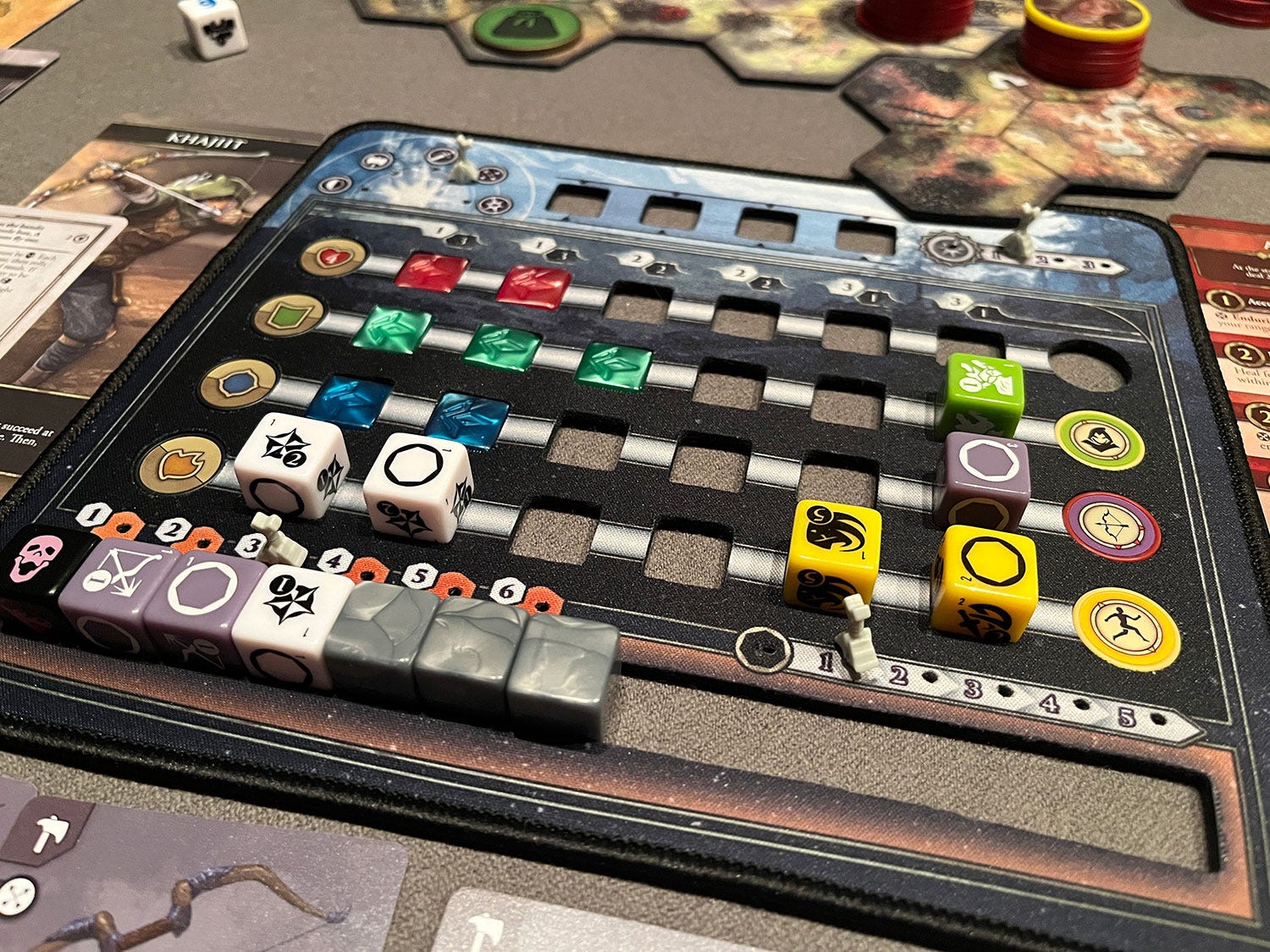
After completing encounters, characters will gain XP which can be spent at the end of a day to level up. Player mats are laid out in four rows, each with a skill at either end. Thus, eventually, in order to level up one skill, you’ll have to forego the ability to progress whichever skill is at the opposite end of the row. Maybe you’ll be a melee-focused tank who levels up his Heavy Armor opposite his Magicka, since he won’t really be using that. Or maybe you decide to be a glass cannon mage, training your Destruction Staff opposite your Health. Regardless, you can either increase your stats or grab extra dice from your chosen skill paths (of which you can grab more from trainers in towns) to have access to in future encounters. While most are used in combat, there are some, like Speech, which are actually used in Peaceful or Town encounters, instead.
This sense of freedom to build out your own unique character feels like a perfect adaptation of an RPG, either tabletop or video game, and helps the game cut down on components by giving you a tree of various roads to go down rather than a whole pile of unique dice specific to your character. Loot also helps to build up your own special toolkit, and it can be purchased in towns or found in encounters and traded around the group. Some items are one-time boosts, some are weapons that have special effects and can be pushed past their limits at the risk of breaking them, and some are wearables that provide ongoing passive effects.
Between your race, class, skill paths, and items, while all characters in Betrayal of the Second Era start out feeling very similar, it’s not long before they all go wildly different directions and hopefully synergize with each other to form a powerful team in battle.
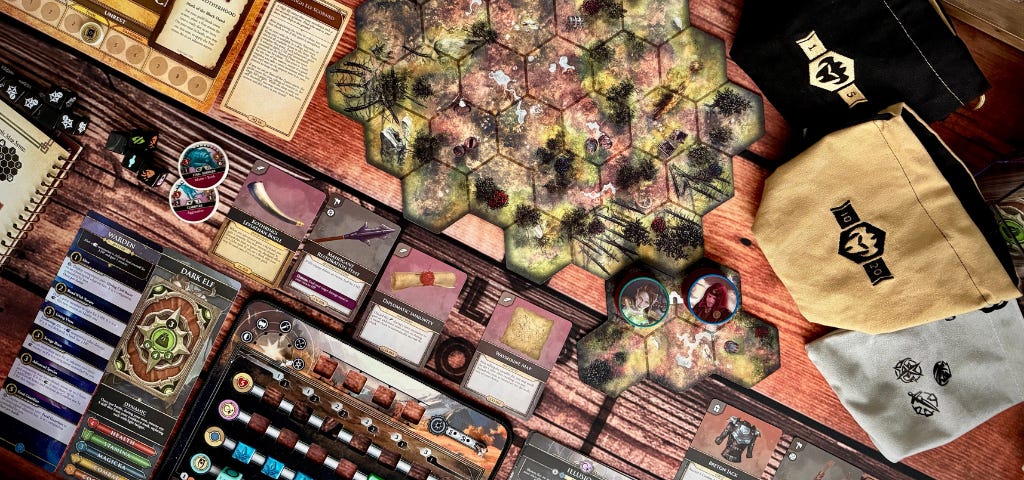
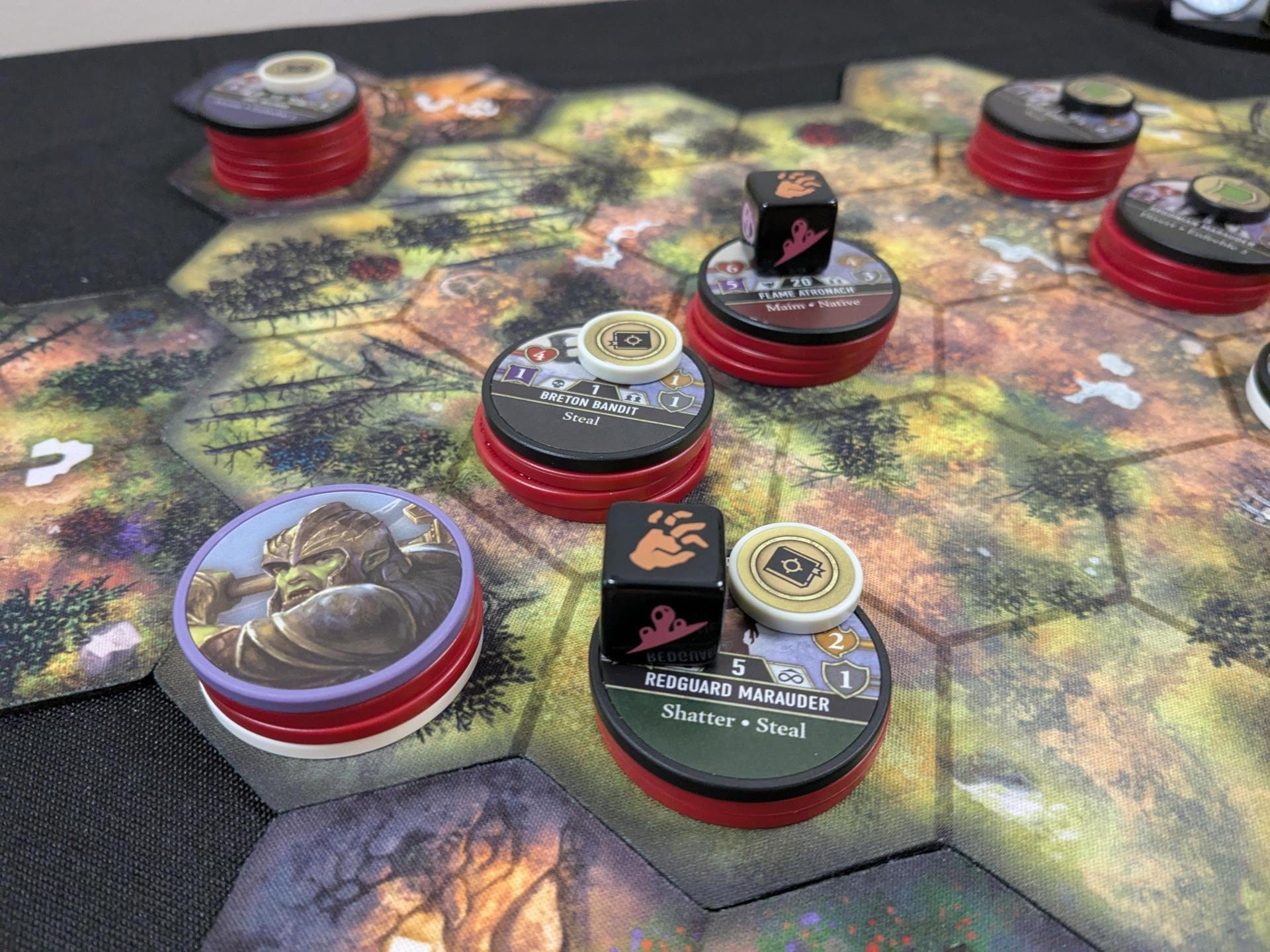
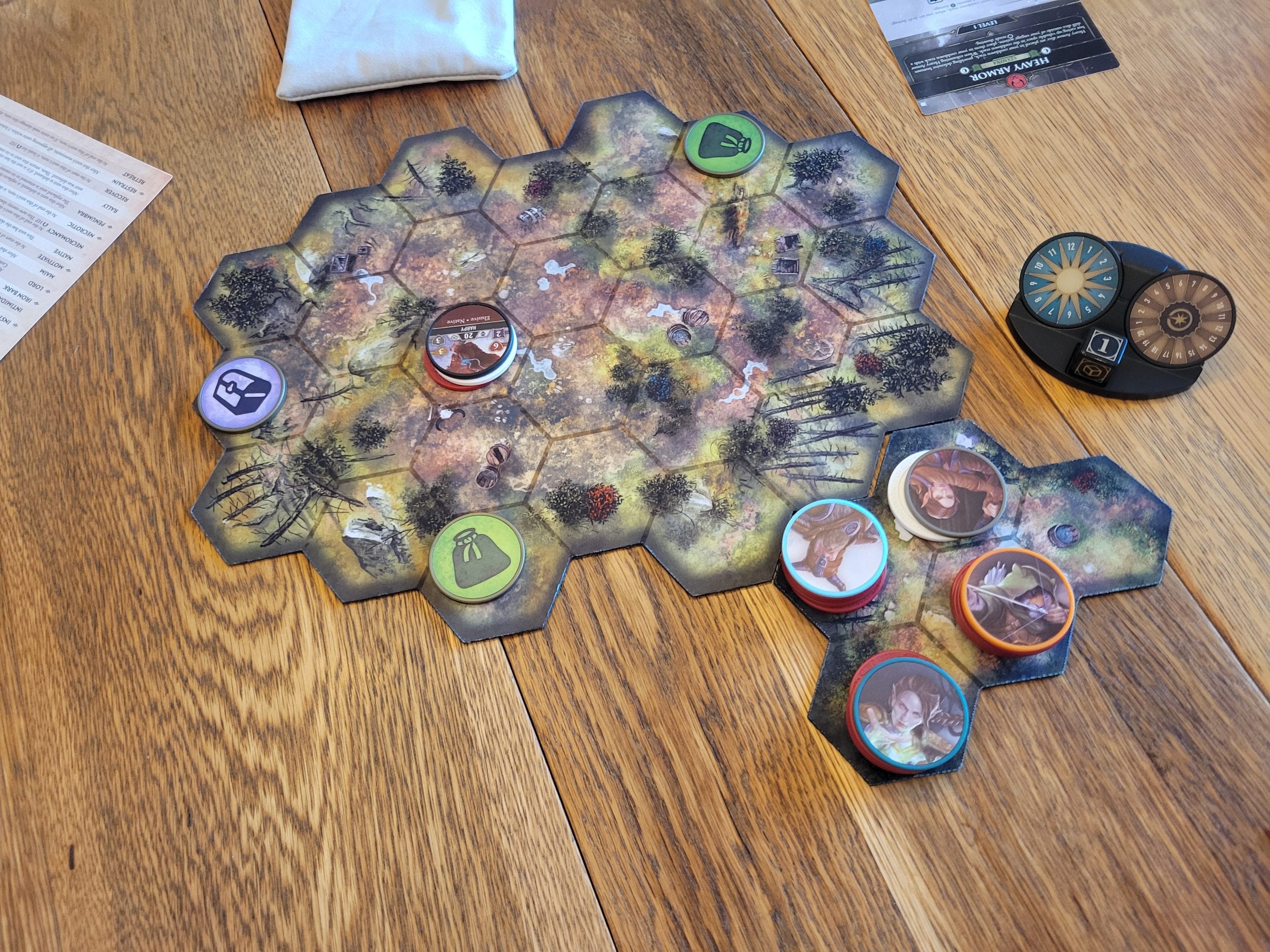
Combat encounters are really the bread and butter of this game, and they come in three distinct flavors: Clashes, Dungeons, and Delves. Regardless of what type of encounter, each battle utilizes a “Battle Queue,” a constructed pile of enemy tokens made to be more difficult based on how far along your quest you are. Enemies come in four levels: 1, 5, 10, and 20, and go into two different bags, one for the double-sided 1/5 tokens and one for the 10/20 ones. The Queue value is calculated by multiplying the number of players by the current day number in the adventure and then pulling tokens of as high a value as you can until the total is reached. Thus, if you’re a group of three on day six, your queue value is 18, made up of a 10, a 5, and three 1s.
Clashes are the simplest form of combat — an all-out brawl on a big hex map where your goal is basically to rout your opponent before they do the same to you. Some of them come with extra nuance or goals to accomplish, but generally these play out like tactical wargames. Enemies all have specific abilities and statistics to reference on the rule sheets, but luckily these things tend to stick in your mind after a few plays. That said, those first few plays before things do finally stick can be pretty rough as you constantly go back and forth between rules and gameplay, trying to figure out just what awful things that giant or wizard is about to do to you.
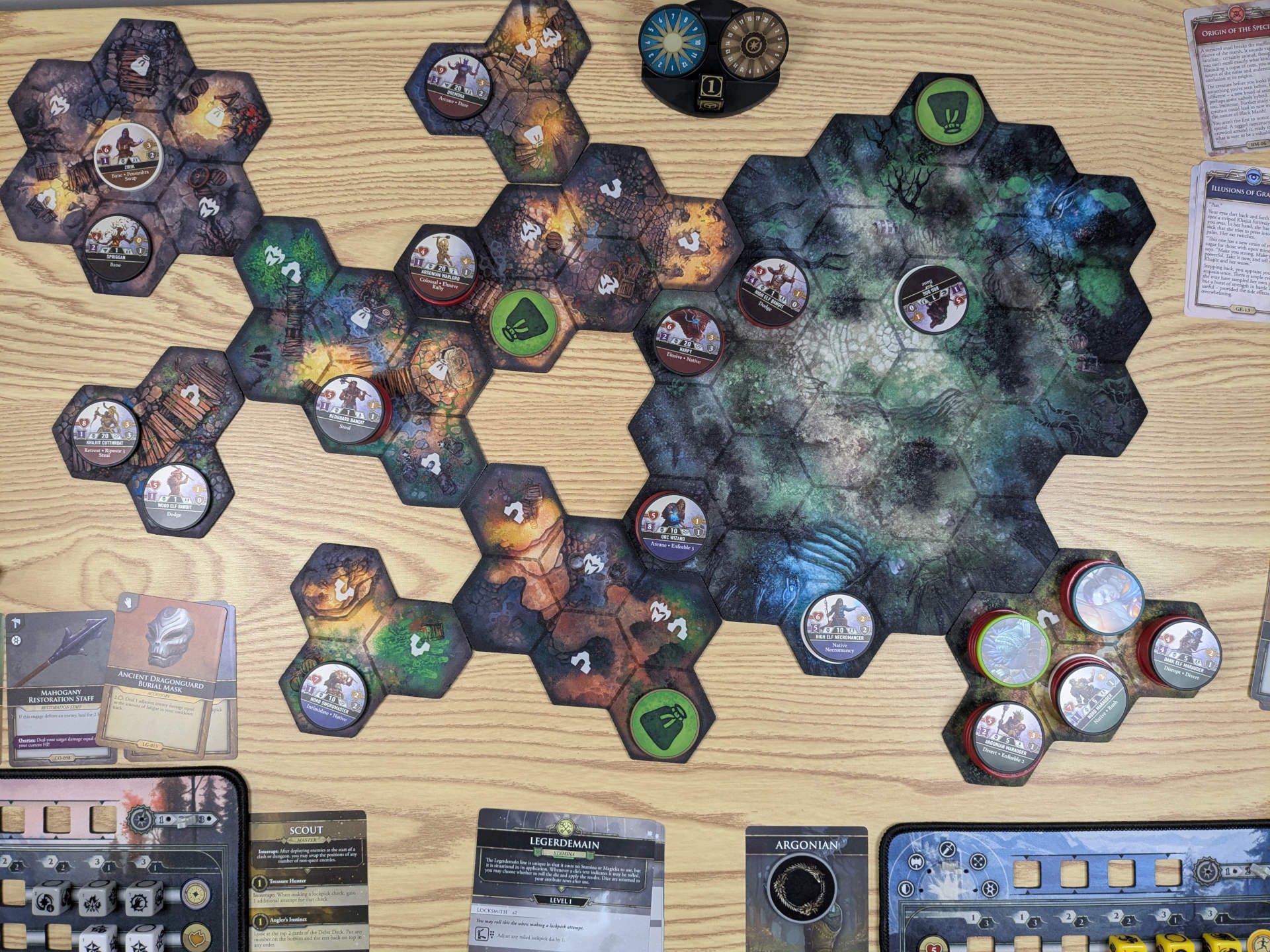
Dungeons are pre-built maps made up of smaller hex tiles in a specific arrangement, with enemies, loot, or other interactables placed on set hexes and a particular goal for players to accomplish unique to that encounter. These are closer to a Gloomhaven-type adventure campaign game where players are dropped into an intricate map. Conversely, Delves are the most complicated, and are a bit like building your own, procedurally-generated Dungeon encounter. Each tile has a few “entrance” hexes, and anytime a player steps on one, a Delve card is drawn, indicating what new room has been discovered, what enemies are on it, and whether or not it provides you any assistance in getting out (most Delve encounters involve collecting “Skyshards” to progress and escape, and they can randomly be found on some cards). Delves feel the most like a video game, as you crawl through a random dungeon that no one’s ever seen before trying to manage your resources and stay alive until you find the exit.
It should go without saying, as a Chip Theory game, but The Elder Scrolls: Betrayal of the Second Era, is absolutely gorgeous. Every piece feels weighty, every piece of art is beautifully drawn, and there’s so much prose throughout that it really feels like a proper fantasy adventure. There’s just so damn much to do in such a relatively small box that it’s frankly unbelievable just how frequently you come across something you’ve never seen or done before. It really does feel like CTG taking lessons from their previous efforts — basically all of the things I love about other entries in their catalog are here, but tighter, more straightforward, and less needlessly complicated.
As I said at the top, if I just sat here and compared this game to others in the catalog like Too Many Bones, Hoplomachus, or Burncycle we’d probably be here all day, but just take my word as someone who’s invested a lot into the Chip Theory ecosystem: this is the very best they have to offer. It’s also just a damn good game on its own right even if you’ve never touched one. Is there a learning curve? Definitely. Some of this is ameliorated by the startup scenario that helps you pick your starting character setup or the Dized app guide, which is indispensable for getting you going on your first adventure (if a bit buggy).
Betrayal of the Second Era is not for the faint of heart. If you like your games lighter, less fiddly, or generally easy to get on the table for most types of gamer, it’s probably not your thing. But if you want a rich, engaging RPG experience in a lovingly-crafted world, have enough friends willing to come along for the ride, and a thick enough wallet to handle its alarming price tag, you really can’t do much better. Chip Theory has a new magnum opus. To be honest, Bethesda does, too.